
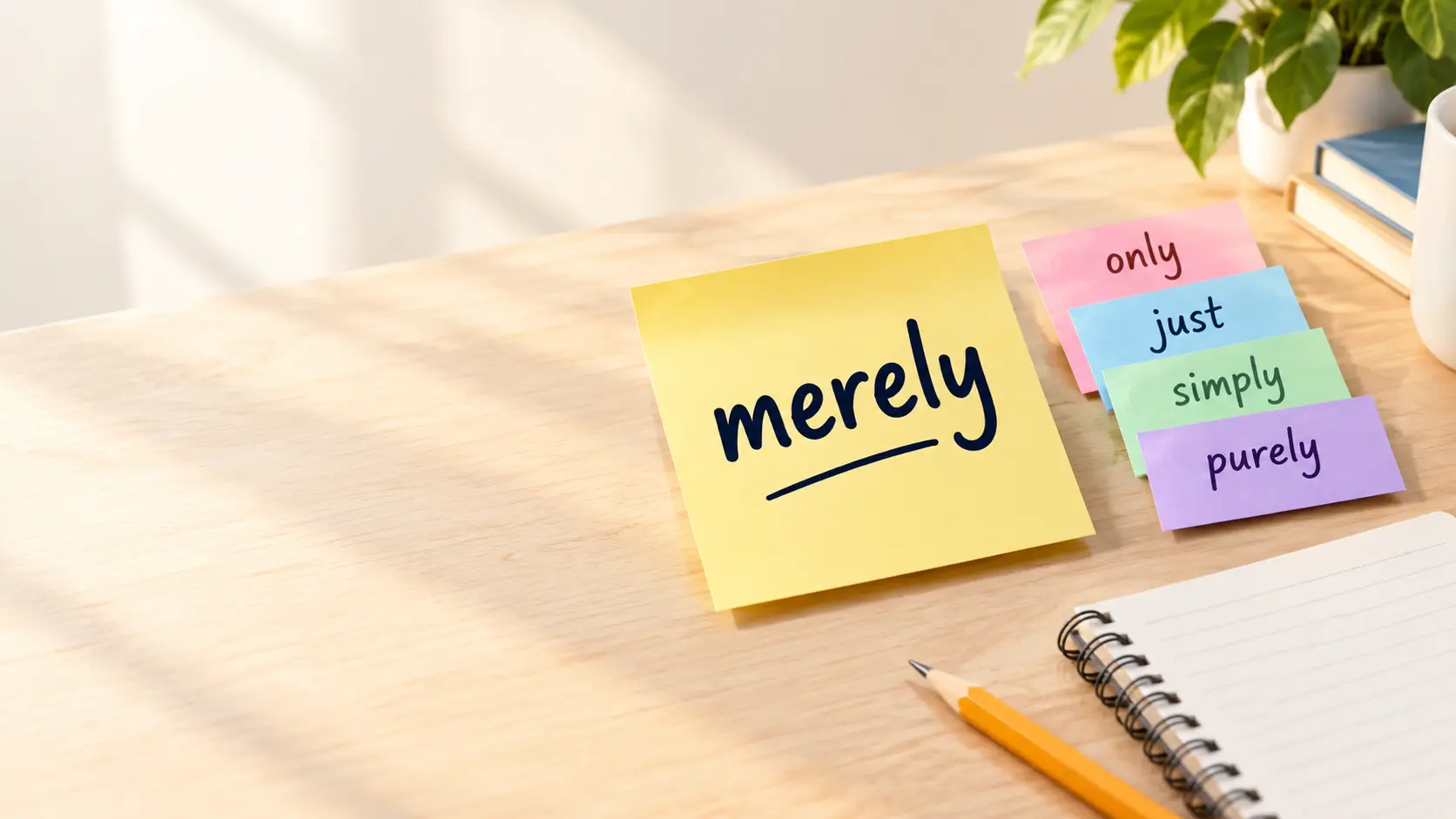
Your friend asks, “Did you win the race?” You reply, “No, I was merely a spectator.” Here, merely means “only” or “nothing more.” It makes something sound small or simple.
Many writers use this word too often. That is where synonyms for merely help. This guide shares 30 easy alternatives, each with a short meaning and two example sentences. Some are exact matches. Others are close, and we label them so you know.
Students, bloggers, content writers, and English learners can all use these words to sound clearer and less repetitive. Pick the one that fits your sentence, and your writing will feel fresh. Whenever you need synonyms for merely, you will find a good option here.
Only
Meaning:
Used to show that nothing or no one else is involved.

Examples:
- I have only one pen in my bag.
- She only wanted a glass of water.
Just
Meaning:
Used in casual speech to mean nothing more than.
Examples:
- It’s just a small scratch on the screen.
- We just talked for a few minutes.
Simply
Meaning:
Used to say there is no other reason or no added complication.
Examples:
- He simply forgot his password.
- I called simply to say hello.
Purely
Meaning:
Used to show that something has no other cause or purpose.
Examples:
- I joined the club purely for fun.
- Her choice was purely about price.
Solely
Meaning:
Used to say that one person, thing, or reason is the only one.
Examples:
- The manager is solely responsible for the schedule.
- He took the job solely for the pay.
Exclusively
Meaning:
Used to say something is limited to one group or purpose and no other.
Type: Near synonym (stronger than “merely”)
Examples:
- This lounge is exclusively for staff.
- The app works exclusively on phones.
Strictly
Meaning:
Used to show that something is limited to one thing and follows a firm rule.
Type: Context specific alternative
Examples:
- The room is strictly for meetings.
- We spoke strictly about work during lunch.
Entirely
Meaning:
Used to say that something is based on one thing with nothing else added.
Type: Near synonym
Examples:
- The decision was made entirely on price.
- Their trip was entirely paid for by the school.
Wholly
Meaning:
Used to say that something is based fully on one thing.
Type: Near synonym (formal)
Examples:
- The blog is wholly written by students.
- The delay was not wholly our fault.
Alone
Meaning:
Used after a noun to mean by itself, with nothing else included.
Type: Context specific alternative
Examples:
- That reason alone should convince you.
- Money alone will not fix the problem.
But
Meaning:
Used in formal or old fashioned writing to mean only.
Type: Context specific alternative (formal or literary)
Examples:
- He is but a child.
- We have but one choice left.
Plain and Simple
Meaning:
A phrase added at the end of a sentence to stress that there is nothing more to it.
Type: Context specific alternative
Examples:
- It was a mistake, plain and simple.
- The answer is no, plain and simple.
Basically
Meaning:
Used to describe the simple main idea of something.
Type: Near synonym
Examples:
- The tool is basically a digital notebook.
- She basically wants a quiet weekend.
Essentially
Meaning:
Used to describe what something is at its core.
Type: Near synonym
Examples:
- The two forms are essentially the same.
- A blog is essentially an online diary.
In Essence
Meaning:
A phrase used to sum up the main point in a short way.
Type: Near synonym
Examples:
- In essence, the rule asks us to be kind.
- The email is, in essence, a friendly reminder.
Nothing But
Meaning:
Used to say that only one thing is present or true.
Examples:
- The road had nothing but dust.
- He ate nothing but rice all day.
Nothing More Than
Meaning:
Used to say that something is small or not important.
Examples:
- It was nothing more than a joke.
- The note was nothing more than a quick doodle.
Nothing Except
Meaning:
Used to show that only one item is included and everything else is left out.
Examples:
- The box held nothing except a few coins.
- He ordered nothing except black coffee.
No More Than
Meaning:
Used to show a limit that must not be passed.
Type: Context specific alternative
Examples:
- The class has no more than ten students.
- The trip took no more than two hours.
Not More Than
Meaning:
A more formal way to set a maximum limit.
Type: Context specific alternative (formal)
Examples:
- Applicants may send not more than two forms.
- Please write not more than fifty words.
Little More Than
Meaning:
Used to say that something is almost nothing but the thing named.
Type: Near synonym
Examples:
- The shed was little more than a wooden box.
- His speech was little more than a list of dates.
At Most
Meaning:
Used to show the highest amount possible, with nothing above it.
Type: Context specific alternative
Examples:
- The repair will cost ten dollars at most.
- We can wait an hour at most.
At Best
Meaning:
Used to say that even in the best case, something is only average or small.
Type: Context specific alternative
Examples:
- The plan is at best a rough idea.
- At best, the movie is average.
Only Just
Meaning:
Used to show that something happened or is true by a very small margin.
Type: Near synonym
Examples:
- We only just caught the last train.
- The soup is only just warm.
Barely
Meaning:
Used to show that something is true, but only by a tiny amount.

Type: Near synonym
Examples:
- I barely know him.
- The signal was barely strong enough to call.
Scarcely
Meaning:
Used to say that something is true only to a very small degree.
Type: Near synonym (formal)
Examples:
- There was scarcely any food left.
- He scarcely spoke during dinner.
Hardly
Meaning:
Used to show that something is almost not true at all.
Type: Near synonym
Examples:
- We hardly had time to eat.
- The rain hardly stopped all week.
Purely and Simply
Meaning:
A phrase that stresses there is one reason and nothing else behind it.
Type: Context specific alternative
Examples:
- It was luck, purely and simply.
- The rule exists for safety, purely and simply.
Nothing Besides
Meaning:
Used to say that no other item is included beyond the one named.
Examples:
- The store sells nothing besides tea.
- She asked for nothing besides a quiet seat.
Nothing Other Than
Meaning:
Used to say that only the named thing will do or is true.
Examples:
- I want nothing other than a fair chance.
- The report showed nothing other than good news.
Conclusion
Learning synonyms for merely gives you more control over your words. Better vocabulary makes your writing clearer, your blog posts fresher, and your speaking more natural. It also helps you say exactly what you mean. Try a few of these words in your next email, essay, blog post, school assignment, or chat with a friend. Start with one or two that feel right, and use them often. Small changes add up, and your English will grow with every sentence you write.

About Matiullah Mughal
Matiullah Mughal is the founder of EliteBloggerHub.com , a digital platform focused on building authority, creating valuable online content, and helping websites establish a stronger presence in search engines. He is also connected with Hexarank SEO Agency, where his work is centered around SEO, content strategy, website growth, and digital marketing.
With a strong interest in search engine optimization and online publishing, Matiullah Mughal focuses on developing websites and digital properties that combine useful content with effective SEO strategies. His approach emphasizes quality, consistency, topical authority, and sustainable organic growth.
Through EliteBloggerHub.com and his connection with Hexarank SEO Agency, Matiullah Mughal aims to contribute practical insights and strategies that help website owners, bloggers, and businesses improve their online visibility and build long-term authority.
Matiullah Mughal — Founder of EliteBloggerHub.com | Connected with Hexarank SEO Agency